The sector
Media and entertainment · Founders’ track record · Thales · 2023
Thales · In-flight entertainment as one experience
In-flight entertainment which knows where the aircraft is going. Platinum Sky: contextual intelligence, device continuity, and destination-aware content.
↑43% user engagement5 platform principles2023 Irvine
Platinum SkyFS 214 · LHR to CDG
BoardingCruiseArrival
CDG · Paris
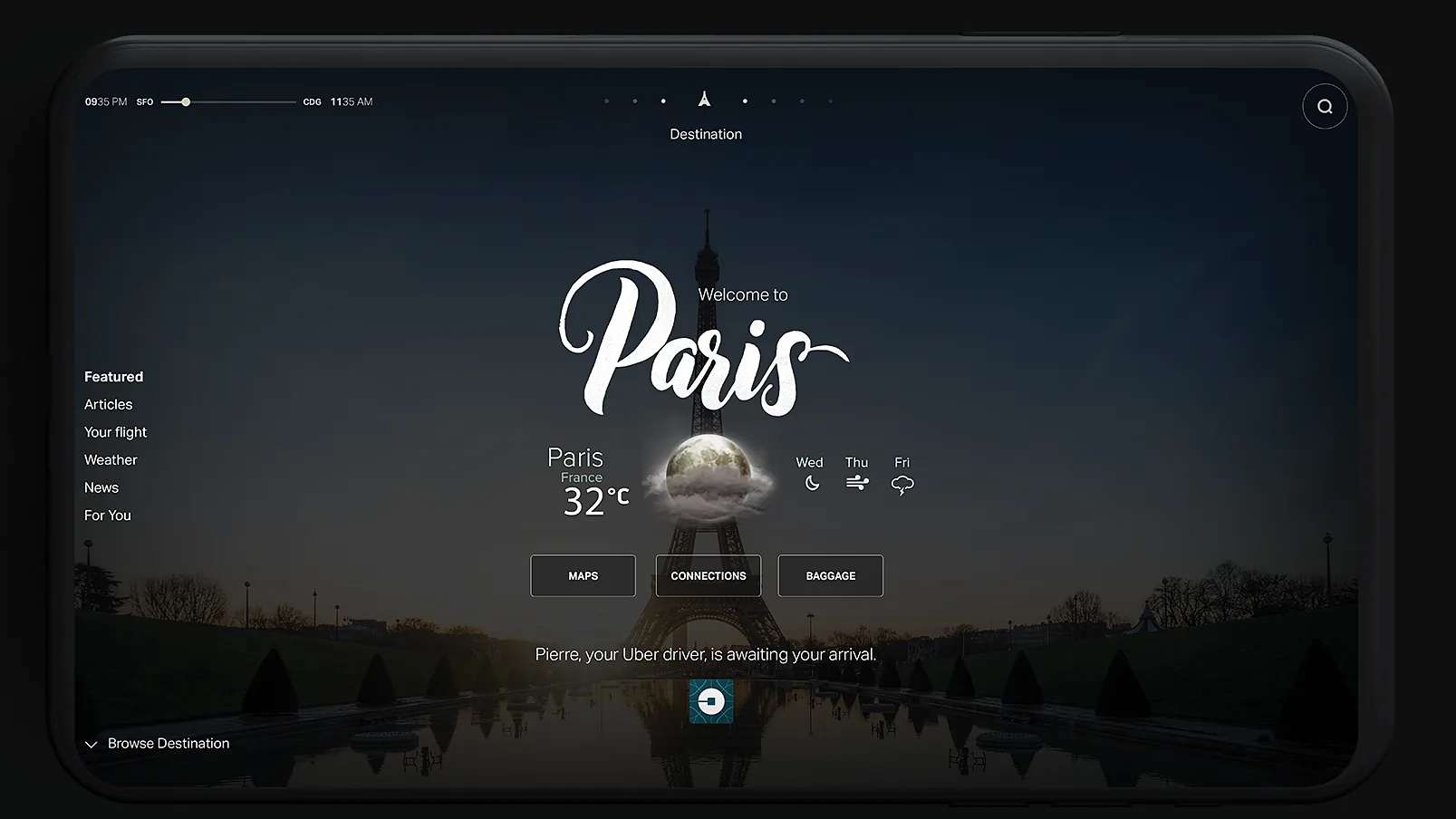
Welcome aboard. The screen already holds your profile, your seat, and your destination.Films, series, and guides ranked for Paris and for you. Continue on your own device, synced at 12:40.Gate B34. Bags on belt 7. Paris at 19 degrees. A table and a car, booked before the doors open.
Ranked on profile and seatRanked on destination and tasteRanked on arrival and city
For you
Paris-bound
The city tonight
A screen in a seat back, competing with the tablet in the passenger’s bag.
In-flight entertainment used to be the only screen on the aircraft. It is now the least personal one. Passengers board with their own devices, their own libraries, and their own expectations of how a system should behave.
Thales asked what the platform becomes when it stops competing for attention and starts organizing the cabin experience instead, from the moment of boarding through to the destination.
We flew with the passengers, not with the spec.
The research read the cabin as passengers live it: what they board with, when the seat back wins their attention and when the bag wins it back, and what the crew ends up explaining by hand. The pattern held across routes. The platform lost every contest against the passenger’s own screen, except the ones about the journey itself.
The seat back cannot win on content. It can win on context.
The tablet in the bag carries a better library than any aircraft will. What it does not carry is the flight: the phase, the time zone, the destination, and the cabin around it. The finding set the platform’s ground. Serve the journey, and the attention follows.
Context is the content only the cabin has.
Five principles, set before a single screen was drawn.
Contextual intelligence, so the system understands flight phase, time of day, and journey. Device integration, so a passenger’s own hardware becomes part of the platform rather than a rival to it. Biometric and behavioural inputs, used to adapt rather than to watch.
Destination-driven, so the content knows where the aircraft is going. And ever-adaptive, which means the system keeps learning across a flight rather than presenting one fixed menu at pushback.
A cabin which knows where it is going.
The defined experience follows the flight rather than the menu: content aware of destination and phase, the passenger’s own device welcomed onto the platform, and a system which keeps learning between pushback and arrival. The screen in the seat becomes the most informed one on board.
AI copilots and ambient sensing, at cabin scale.
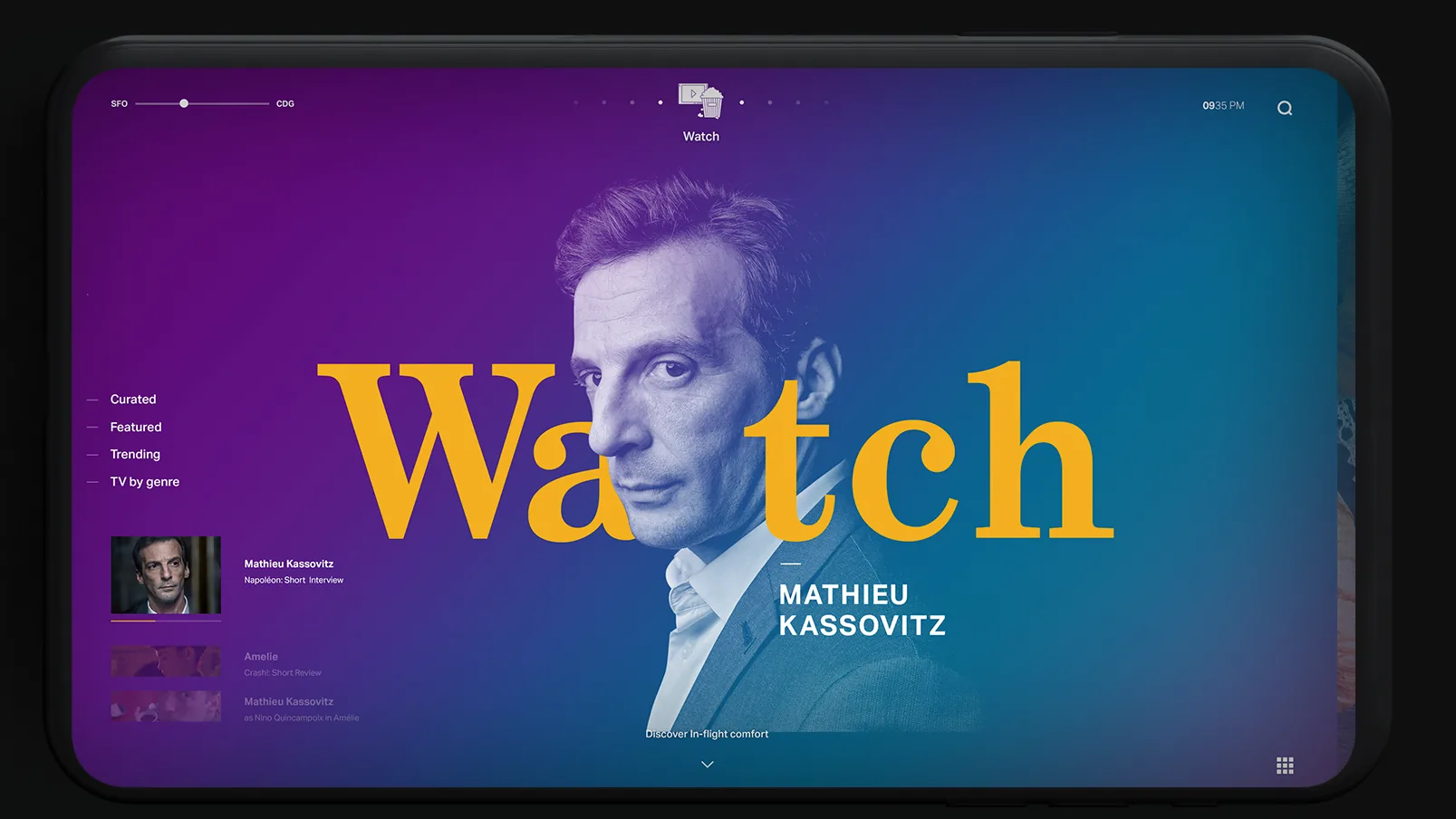
AI copilots guide a passenger through choice rather than bury them in it, with ambient passenger sensing feeding the adaptation. The interface holds across the seat back, the personal device, and the cabin itself, so the experience follows the passenger rather than the hardware.
Platinum Sky was shown at the Aircraft Interiors Expo, which is where this industry decides whether a cabin concept is real.
Contextual intelligence
The system knows flight phase, time of day, and journey.
Device integration
The passenger’s hardware joins the platform rather than rivals it.
Ambient sensing
Biometric and behavioral signals feed the adaptation.
AI copilots
Choice guided, not buried.
Every surface
Seat back, personal device, and cabin, one interface.
Five principles
Platinum Sky, shown where the industry decides what is real.
A measured lift in how much the platform gets used.
↑43%
user engagement against the prior platform, measured on the system itself
5
platform principles, set before a single screen was drawn
Engagement rose 43% against the prior platform, measured on the system itself. That is the honest result to report: passengers used it more, and used more of it. Anything beyond that sits with Thales and its airline customers, and is theirs to publish.
Record. Thales, Irvine, California. The in-flight entertainment division of the French aerospace and defense group.
Work led by Formist’s founders in prior practice.
Discipline. In-flight entertainment · contextual systems · interface design.
The point. A captive audience is not a captured one. Attention in a cabin still has to be earned, hour after hour.
Platinum Sky, on the seat back.
Every screen below sits in the back of an aircraft seat. The passenger is belted in, the flight is under way, and the unit is an arm’s length away.
The future of flight is entertainment which knows the journey.
Bring the ambition. Start a conversation.